Evolution

In some American school districts there is an ongoing debate about whether evolution should be taught to students. Many Christians believe that evolution is “only a theory” and that it is incompatible with their creationist worldview. As a result, ideas like intelligent design have creeped into the curriculum of some schools, and many people advocate teaching creationism alongside evolution. Tanzanians have developed an interesting way of combating this problem: evolution is taught in history and biology, but nobody believes it.

The other day I had a fascinating conversation with two students – a Christian and a Muslim – about religion (so, in a sense, we had a representative of the three Western monotheistic faiths), and ultimately we ended up talking about evolution. I have discussed evolution with some other students prior to this, and talking with other WorldTeach volunteers it sounds like across Tanzania everyone learns evolution, but doesn’t believe it.

These students were able to clearly explain the theory of evolution, but explained that outside of school they did not believe it. They are literal creationists – God created Adam, and then Eve (Eva) from one of his ribs. These students were the first to explain to me that in school they believed in evolution, but outside of school they did not. I told them that this was an artificial dichotomy (first I had to explain those words), but in the end they told me that they simply did not find evolution compatible with their faith. I explained that many religious people interpret the bible as a metaphor so they did not have to interpret it literally, but religion is really conservative here, and I am sure there are almost no churches that teach a version of religion that is not consistent with a literal interpretation of the bible. Around this point, one of the history teachers walked in, and began to engage the conversation. History is taught from pre-history here, so he is one of the teachers who actually teaches about the origin of man. He asked a series of really insightful questions of the students, and they didn’t know how to respond. Then, he said it was important for them to think about these things. Later, I asked him if he believed in evolution. “Of course not,” he said, “for evolution to be true we would have to be evolving right now. From what I can see, we are not.”

Yet, for some reason, this teacher, and teachers like him, continue to teach evolution, and do not seem to mind that it is in the curriculum, which strikes me as somewhat odd, given how fundamentally religious most Tanzanians are. It seems like Tanzanians are taught about evolution at an early state – beginning in primary school – but everything they have learned about the world up to this point is framed by their religion, which teaches that God created Adam and Eve, so evolution is therefore something that they must learn, but simply isn’t true. Of course, many students are unable to explain what evolution is actually about (“We didn’t come from monkeys!”), but even those that are capable of explaining the specifics simply choose not to believe it. If only things were so simple in America.

Posted in Uncategorized | Tagged , , | 2 Comments

The colonial legacy in schools

“When Europeans came to Africa, they saw that Africans were lazy. To make them work hard they knew that they would have to use the stick to teach them about how hard work is important. Somehow, that is why we use the stick today. Our students are lazy, and we must help them work hard.”

As with my previous posts, this quotation does a poor job of capturing Tanzanian English usage, but this story is one that I have heard from three of my fellow teachers, two of whom teach history and civics. One of whom studied politics at university. As an American who studied African politics and history, this is a surprising thing to hear said by a Tanzanian. Indeed, if one of my fellow students in college had said something similar, justifying the use of beating, I would absolutely have accused him or her of having a neocolonialist (or just straight colonialist) attitudes.

Indeed, to assert that Africans were lazy prior to colonialism is ludicrous. First, we must examine what the word lazy means. We think of laziness in opposition to hard work: people who work hard are not lazy. So, what did hard work mean in a pre-colonial context? It means working hard enough to provide for your family. Often, this entailed long days of work on farms, hunting, gathering, or herding. Survival itself was hard work.

In a colonial context, hard work meant working for the colonialists, building their buildings, roads, and railways; working on their farms; or taking care of their children. All work that, to use a marxist term, alienated Africans from the fruits of their labor. They had no incentive to work hard, because they were being paid close to nothing to do work that had no real importance for them. If they worked harder on the farmland that had been stolen from them, land that they now worked as sharecroppers, they would not get paid any more. And, on top of that, the land had been stolen from them, appropriated to colonial settlers (this example is specifically drawn from the Kenyan colonial story, but similar things happened throughout Africa). So, to force their African workers to work harder, to keep their workers controlled, Europeans beat them.

Certainly, in pre-colonial Africa there were those people who worked hard, and those who did not, but that is undoubtably true for everywhere in the world. It is only when people begin to work directly for other people that the employers (the people who we might call capitalists), begin to worry that their workers are not working as hard as they can. This is a justified fear, because if their is no incentive for hard work, why should the vast majority of people work hard?

There are two ways to approach this problem. First, you can negatively incentivize laziness, and poor work. This is the colonial approach to labor problems. You beat workers who are not working hard enough, and you coerce your labor using fear tactics. Or, second, you can positively incentivize hard work – you can give workers something to buy in to. You can reward hard work with wage increases and a stake in profits, and you can encourage your workers by treating them with respect and dignity.

One could, probably accurately, say that colonialists had no choice – they had to adopt the first approach, because they were already aggressors, and Africans would have had no true incentive to work them without negative incentives, because they already had lives and traditional systems that worked for them. However, in Tanzanian education there is a choice. Students, by in large, want to learn. Laziness is no more a problem here than in America, and many students here work much harder than their American counterparts. Certainly there are lazy students, but now teachers have two real options for dealing with students: they can negatively incentivize what they see as laziness (which, actually, by in large is not even laziness), or they can try to positively incentivize hard work, by supporting their students, encouraging them, and trying to teach them tools to help them succeed.

One of the real sources of laziness in Tanzanian schools actually comes from the teachers themselves. Admittedly, most teachers have class loads that they cannot realistically handle, but many teachers approach this problem by not going to class at all, or presenting lessons that consist wholly of students copying the notes they write on the board. Perhaps the real solution for laziness in Tanzanian schools is to have the headmaster beat teachers who are not living up to the expectations of their job, to “help them work harder.”

Posted in Uncategorized | Tagged , , | 2 Comments

Freemasons and Tanzanian Superstition

One of the more interesting queries I get from Tanzanians involves freemasons. “What do you know about freemasons?” they ask. Often this simply comes up out of the blue, as though it is simply a topic that they have a strong desire to ask an American about. Other times, it comes up because I am asked about my musical tastes, and wanting to say an artist they will recognize (but also a musician I actually like a lot) I say that I like Jay-Z. The typical response to this is, “But, he is a freemason!”

How freemasonry became a topic of interest in Tanzania is far beyond my knowledge of the topic. Indeed, in America, most people tend to think of freemasons as part of a secretive society, but aren’t too worried about them. Of course, there are some conspiracy theorists who would, perhaps, suggest that freemasons are a group of rich and powerful people who have an international conspiracy to control the world, but most people don’t give such a theory much weight.

So, when people ask I say, most Americans don’t believe in freemasons, but that some people might say that freemasons are composed of ultra-rich white people bent on controlling the world. Thus, Jay-Z cannot be a member. Tanzanians do not agree with this assessment. “He must be a freemason,” they say, “how else could he have become so rich and famous?” I respond that he made really popular music, but that does little to convince them. Indeed, I think both my explanations of what Americans think about freemasons, and what I think about freemasons (just about nothing at all) are quite disappointing to Tanzanians, who, I think, expect the inside scoop on freemasonry.

Most Tanzanians think that to become a freemason you must kill a baby, or maybe an old person. They think freemasons do not believe in God, but they are all rich, because if they become a member they are given lots of money by the other members. If someone becomes rich quickly, people assume that he or she is a freemason. If you don’t believe in freemasons, you are delusional, or not paying attention.

Freemasons are among the many superstitions that Tanzanians place a great deal of stock in. The following conversation – written from memory, and poorly capturing the flair of Tanzanian English – illustrates:

“Do you have witchdoctors in America?”
“No.”
“Well, what do you do about all the witches?”
“We don’t have witches.”
“There are witches everywhere.”
“Not in America.” (What I wish I had said here was, “we got rid of all of ours in the 17th and 18th centuries”)
“Well, do you have people that pray under trees?”
“Oh, yeah, we call them pagans.”
“Well, those are witches. How do you free them possession if you don’t have witchdoctors?”
“Well, we don’t force pagans to stop praying underneath trees, but people who are mentally ill go to mental hospitals.”
“Oh, you have hospitals for the possessed?”

Traditional pre-Christian Tanzanian beliefs, have melded oddly with Tanzanian Christianity, and globalized American culture, creating a climate where many people believe in many superstitions, and not all these superstitions are as harmless as they might appear based on my interactions with Tanzanians. For instance, a Christian teenager recently peed on a Koran because a superstition suggested he would turn into a snake, and he wanted to see if it was true. Of course, Muslims had an intense reaction to this defilement of the Koran, and there were riots that resulted in the burning of at least a couple Christian churches. Likewise, albinos still have their limbs amputated, because some witchdoctors use them in potions. Luckily for rich Tanzanians, as far as I know nobody is killed for being a freemason. After all, if you believe in the power of freemasonry, the consequences of killing a freemason would probably be very dire.

Posted in Uncategorized | Tagged , | Leave a comment

“At home” – Living in Tanzania

I was asked recently by a friend what I feels like to be living in Tanzania. I have tried to keep my blog detached from my own emotions and feelings, in order to try to capture, somewhat objectively, what life is like here, and to be able to more effectively explain my life by detailing what actually happens. In short, I have tried to leave it to my readers to make their own judgement about my experiences. Today, I thought I would try to give you more insight into the emotional particulars of my experience, as best I can.

My answer, to my friend, was that it feels like home. When I was out of town last weekend, it felt really weird to be a tourist again. On top of this, I have reached the point where I feel relatively well adapted to all of the crazy things that happen here. I don’t feel as surprised or shocked by events in my day to day life. If something odd happens, I just chalk it up to “Tanzania” and move on. I expect that at some point something so completely shocking will happen that I will have no choice but to be blown away, but I have adapted to life in Ngara, and all the routines that last July I simply would have been unable to imagine.

I don’t feel like I am part of the culture, and I don’t think I ever will, but I have a decent understanding of what the Tanzanians I interact with are like, even if sometimes I have no idea why they do some of the things they do. The people I know are all very different, but at the same time, as an outsider, their cultural similarities are so glaring that I really do feel like I have begun to understand – as best as an outsider can – what kinds of things Tanzanians value, and the myriad ways that their social interactions are so different than my own. I often wish I understood more of the many conversations I overhear, but my language skills and understanding of some cultural nuance generally allow me to pick up the general meaning of a conversation, even if the complete picture eludes me. I think this is the biggest way in which I feel I am an outsider, unable to fully understand Tanzanians because I get an English version of their thoughts and ideas.

Still, I find myself unconsciously adapting Tanzanian phrases (this is definitely worth another post at some point), and feeling a sense of shock when things are extra-ordinary beyond Tanzanian extra-ordinary. For instance, on Friday two wazungu (white) women came to my school to teach hip-hop dance during sports and games. That in itself was a surprise, as Tanzania is pretty conservative, and a lot of hip hop dance edges on sexually explicit. Despite this, the Tanzanian (or Kenyan) version of MTV airs music videos that are just as explicit sexually as MTV. In any case, I had met these women previously, and found it very pleasant to chat with them, as they are very nice. However, one of my first thoughts was actually “I can’t believe she is wearing spaghetti straps.” So, on Friday I was not entirely surprised to see them both wearing skin tight workout pants, but nonetheless still very shocked. Pants – form fitting jeans especially – push the envelope here, and to wear something so skintight is close to nakedness in the minds of Tanzanians. I was happy at least that their pants covered their knees, because the knees are a very sensual body part here. I told them – feeling a certain degree of awkwardness – that next time they should wear shorts over their pants, or something much looser, because what they had on would attract a lot of attention.

I was gratified, though also embarrassed, when one of the female teachers I work with said, “your wazungu friends, they are so tight.” I said, “Oh, you mean their pants, we would call that skin-tight. I told them that it was not so acceptable here to have such tight pants.” She said, “Oh yes, they are naked to us. We are not used to this clothing. They will get much attention from the students.” And so, I was not only a cultural intermediary, but also unable to avoid the association of my own difference. I am sure I have embarrassed myself by not understanding some of this conservative cultural nuance as well, but in this case, and later, as I explained some things about life in Ngara, I couldn’t help but feel like a cultural insider, at least by comparison. This kind of adaption is an ongoing process, but certainly one that I feel defines my existence here to an extent. I will always be an outsider, but I am more of an insider than any tourist will ever be.

Posted in Uncategorized | Tagged , , | Leave a comment

Travel in Tanzania

Some previous posts have discussed Tanzanian travel, but having just finished a weekend trip with its own share of adventures, I decided to take a post to discuss the bus system in a little more depth, in light of that trip.

The first thing you realize when you try to get a ticket to a bus in Tanzania is that the busy system is extremely unorganized, yet somehow Tanzanians make things work. When you enter a large bus station at a regional hub, you are quickly surrounded by people trying to convince you to take their bus, and they take this very seriously. There are a large number of major, Greyhound-style (minus the bathrooms) bus companies in Tanzania, and while most of them have specific routes or types of routes that they specify in, by in large the competition is fierce between bus companies running on the same lines. On top of this competition for customers, the actual bus stations themselves offer little in the way of clear organization. It is unclear where busses wait to leave, and where you need to be to catch the bus you want. However, the bus companies seem to make it work, and I have never been unable to figure out where I need to go, though not without some confusion.

For instance, this weekend I was returning to Ngara, and had purchased a ticket at TAQUA, a bus company that specializes in cross-border trips. They run a bus both to Kigali and to Bujunbura, and both these busses go directly through Ngara district. However, they do not run every day, and only one of them goes directly through Ngara town, the other passes through a town further away, but it is a short taxi ride from town. So, I bought a ticket and was assured that on my way home I would be taking the Bujunbura bus. On the day of my travel, I was sitting and waiting for the bus, at the bus office. After a delay, I was told to follow a representative from the bus company, who led me to a Falon bus. I was very confused, and after a long conversation where I insisted this was the wrong bus, they convinced me that it was indeed the bus I had bought a ticket for. It wasn’t, but it was going in the same direction, and I guess maybe the Bujunbura bus wasn’t running that day. The Westwardly bound busses headed for Ngara region all stop in a city called Kahama for the night, and I knew that the next morning, since I did not want to continue on this bus ( it was going to Bukoba, which is over 100 km North of Ngara town), I would be able to catch a coaster.

A coaster is a smaller bus, ranging from the size of a small van, to about half the size of large passenger bus, that makes shorter trips between cities. I discussed this with the conductor of my bus, who eventually agreed to pay for the coast of my coaster, given that I had been assured that my bus was going to Ngara town. At 5 am, I woke up (or rather, was still awake, since sleeping on a bus is difficult, even when it’s not moving), and had the conductor lead me to the specific coaster. He took my ticket, had a conversation with the driver, gave me a thumbs up, and left. Busses in Tanzania not going very long distances wait until they are full before they leave, so that the driver is able to maximize profit. This one was full by 6, though not without some arguments breaking out among passengers, about who had claimed seats, and who had not. Sometimes people will wait for hours on hours for the bus to have enough people to go.

Eventually, we were underway, and I discovered that I would indeed have to pay about halfway through the trip. This coaster was ever so slightly larger than a small van, with 3 rows of three child-size seats, and a fourth seat in each row that folded down in the aisle. These seats did not have backs. There were two more seats up front, not including the driver’s seat. Full enough to leave meant that every seat was full, and that 3 men were sitting on a ledge facing into the back of the van. So, when we left, there were 18 passengers, plus the driver and the conductor. As we drove, people came on board, and left, but for most of the drive we somehow managed to squeeze an additional 10 passengers into the van. One more squeezed onto the ledge, the already small seated rows had another passenger added each, and six people stood in no space. It was a trip, and I am glad that it was only a three and a half hour ride in this coaster. This is a very common practice for just about any small transport in Tanzania.

In the large busses, at least, you are generally guaranteed your own seat, unless there aren’t any more. On the way to my destination in this trip, about 3 people stood through the night because there were no seats. Another 3 were sitting on plastic containers. In the middle of the night, when many passengers, myself included, were sleeping, we went over a speed bump really fast. Shouts rang out, I banged my head rather hard and had to spend the next hour working out my next, and the lady behind my lost her two front teeth. Yes, she l lost her two front teeth. One of the was fake apparently, but after the initial shouts died down she continued to scream. Somehow she had banged her teeth directly on to the very hard plastic of my seat back and they had both come completely out. Another passenger handed her a handkerchief, and as the bus continued on its way, her moans of pain began to dissipate. It’s all in a night of Tanzanian travel.

Posted in Uncategorized | Tagged , , | Leave a comment

My Tanzanian Diet

One of the best things about living in Tanzania is the food. While Tanzanian cuisine isn’t (generally) that amazing, Tanzanians do the simple things well, and basic foods like rice, pilau, stewed plantains (green bananas) potatoes, beans, green vegetables, fried chicken or turkey, and tomato sauce (normally with a very tough meat) are the staples at most of the restaurants (known at hotelis) in Ngara. Bars serve an omelet with fries known as chips mayai, mishkaki (skewers, typically goat, but sometimes cow), fried plantains (which are fantastic), and fried goat (that can be seriously delicious, especially after a few beers). If these were my options on a daily basis I would be reasonably happy, as a very big plate of food is never more than 4,000 shillings (or just over $3). But, on top of these prepared options, Ngara is centrally located in an agricultural area, and at the market every Saturday near my house I can get some of the freshest food at the most ridiculous prices. And, as you may know, I love to cook, so this is something of a dream.

There is a permanent market in town that sells most of the things I can get at the market by my house on Saturdays at increased prices, but I rarely go there unless I happen to run out of things, because this market, known as Kojifa, is seriously one of the coolest things about life in Ngara. I can buy many things that include green bananas; small, sweet, yellow bananas (I don’t really like bananas at home, but these are simply amazing); other varieties of bananas; green peppers; avocados; eggplant; carrots; onions; tomatoes; okra; sweet potatoes; yams; normal potatoes; cassava; sugar cane; over five varieties of green leafy vegetables that Tanzanians refer to as mchica, but range from spinach-like to chard-like; at least eight bean varieties (dried or undried); and a bunch of other things I am sure I am forgetting. The prices on these vegetables are unheard of in America. A bunch of green leafy vegetables that would cost $2.99 in America go for 100 shillings here (less than $.10). Two large eggplants cost 1000 shillings (about $.70). Five large sweet potatoes cost the same. A large avocado? $.10-.20 cents. In short, eating well here is easy, and I have so many options to feed myself well.

I will use the last two major meals I cooked as an example. I cook all my food on two charcoal jikos (which are like miniature grills without the grill). Yesterday, I made a pot of beans, and as they finished cooking I added some sautéed onions, hot pepper, garlic, and salt. While the beans were cooking, I chopped up 6 green bananas, and boiled them in water. When they were done, I added the bananas to the beans and let them soak up some of the delicious flavor that had developed in the bean pot. This meal was served with avocado, and my version of chapati (which is a kind of Tanzanian tortilla). The next day, there were leftover beans and bananas. I also boiled some potatoes, and began a tomato sauce, which consisted of sautéed onions, carrots, garlic, hot pepper, salt, and of course tomatoes. I added a little bit of this sauce to the potatoes, and made a kind of tomato-mashed potatoes. To the rest of the sauce, I added chopped eggplant, and ginger, and cooked until the eggplant was tender. To finish the meal off, I heated a bit of oil, and tossed in two heads of a green vegetables that are quite similar to chard, finishing it off with a bit of garlic and salt (this is the only thing I make in a truly Tanzanian style). Delicious.

I swear, every week the food here gets better, as I continue to pick up jiko tricks, and new ways of adding flavor to the food. But really, everything is so fresh that the food doesn’t need a lot of spices to make it good. In the states I found myself relying on a wide variety of spices, but here the only things I use regularly are garlic, ginger, hot pepper, and of course, salt. In fact, the food that I cook here might actually be better than some of the things I make at home, though I’d be lying if I said I didn’t miss burritos, a nice cut of beef, and tender chicken.

Posted in Uncategorized | Tagged , | 1 Comment

The short trip to Kigali

A couple weekends ago I went to Kigali with the other Ngara WorldTeach volunteers (there are four of us in all). We had all wanted to visit the city for a weekend, and having been told by my Field Director that I might have to spend three days and two nights to extend my visa, we made plans to go. Ultimately, my visa situation was sorted out, but since we had already made the plans we decided to go anyway. It was a nice – if very short – trip.

We left early Saturday morning, catching a “taxi” to Benako, a small town that was once the site of a large refugee camp during and following the Rwandan genocide, and from there we continued in a taxi to Rusomo. Ngara town is only 26 kilometers from Rusumo, but for some reason all the taxis go through Benako, which is actually pretty out of the way, and adds maybe double the distance. It is 3000 tsh (or about 2 dollars) to get to Benako, and other 3000 tsh to get to Rusomo. “Taxis” are Toyota hatchback sedans that uncomfortably fit up to 14 people. On this trip we we lucky to be the only four people squeezed in the back seats. I think because we are wazungu, they didn’t force anybody else on us, and four people crowded in the trunk, while three more crowded up front with the driver. Yes, the driver shared a seat.

We arrived at Rusomo about an hour later, and walked to the Tanzanian immigration office to get our passports stamped, before we crossed the border. We walked down a long hill full of trucks waiting to get their turn to cross the bridge over Rusomo falls into Rwanda. People had been telling us we had to go to Rusomo to see the falls, but they were not really that special, and I am glad we did not go solely to see the waterfall, because it was nice but completely unspectacular (and very brown). I would call them a lesson version of Whatcom Falls, in Bellingham, if that helps you gain some perspective on them. The one lane bridge that crosses the river is the border, and once you cross the bridge you meet with Rwandan immigration on the other side. We quickly realized that this is why there were so many trucks waiting to cross. Not only does it seem like they have to deal with immigration, but after crossing the border trucks begin driving on the other side of the road (in Rwanda the roads are like the US, while in Tanzania the roads are like the UK). I can only imagine this is difficult for truck drivers to adjust to, but the single lane bridge that shakes like it will collapse when trucks drive over it makes this transition a little easier, I guess.

After crossing a border, we hopped on a bus. Conductors from three different companies ran to us trying to write us tickets for their busses, but we ended up hopping on the one that was getting ready to leave. The busses leave Rusumo nearly empty, because not many people cross the border, and pick up passengers on the way to Kigali, which extends the time of the journey somewhat. For 3000 francs (about 6 dollars), we got all the way to Kigali. By the time we arrived in Kigali we had been traveling for just under 6 hours. On the way back it took us closer to 5, because the busses leave Kigali full, and don’t pick up as many people on the way.

Entering Rwanda two things became very clear: Rwanda is much cleaner than Tanzania, and the busses are much nicer. It is clean because plastic bags are actually banned there, and once a month it is the law that everyone takes a day to clean (picking up trash, etc). Most of the busses are relatively new, and they are far more comfortable than Tanzanian busses, even if you end up squeezing an extra person in an aisle.

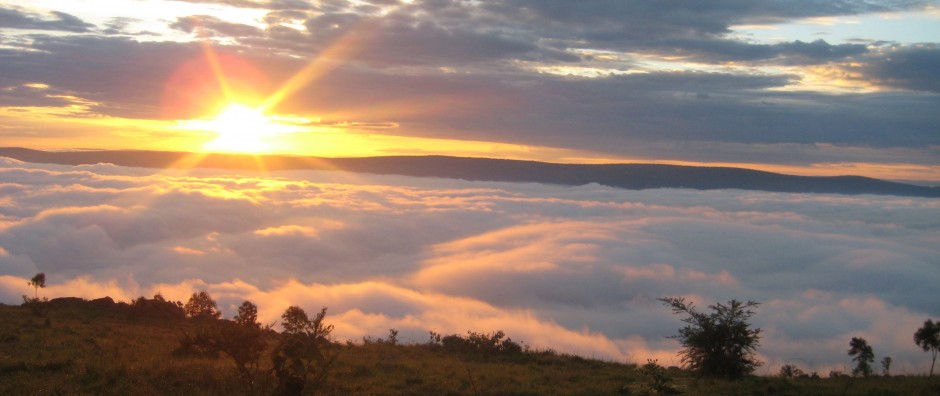
Rwanda looks a lot like the landscape of Ngara, but it is much more densely populated, so there was not a single stretch of road that didn’t have houses alongside it, and there were farms everywhere. Unlike Ngara, there were also rice fields, and what I think were artificially made fishing lakes. And, of course, there were banana farms everywhere. Kigali was very pleasant. It reminded me of Pretoria, South Africa, without the crime problem or townships. Obviously there is a wealthy upper class in Kigali (and the associated mansions, high walls, and barbed wire), but these differences are not as stark as in Pretoria, and the city is supposed to be very safe. We stayed at a hotel in the city center, which is on the middle of a hill. Kigali is very hilly, and it seemed like there were no streets without an incline.

We only had the rest of the day, and the next morning in the city before we had to leave, so we explored, ate food, and saw some of the sights. We also managed to have an adventure involving a search for a restaurant that was recommended in my Lonely Planet guidebook. As it began to get dark, Marisa, Elizabeth and I (with our computers) walked in search of this place. It got dark, and we asked a policeman if he knew where it was it. Already this story is quite different than the story I would be telling in most big cities in Africa, because you avoid policemen because they are corrupt and you never walk around at night (especially with valuables). That’s not to say that we should have been walking with valuables, or that walking after dark is a fantastic idea, but Kigali is supposed to be the safest city in Africa, and there were policemen everywhere. The first policeman had no idea where it was, but the second did, and called us some motorcycles to take us there, even though it was just around the block. We hopped on our motorcycles, and I quickly discovered that my driver had no idea where we were going, and didn’t speak any English or Swahili.

We spent the next 20 minutes driving around in the dark, temporarily losing each other (because the drivers did a poor job of sticking together), as the drivers tried to figure out where they were going. It was a little terrifying, and my adrenaline really began to pump. I pulled out my iPad, which I instantly regretted to try to show the driver the map of where the place was supposed to be, and he puzzled over it before I put it away, not only feeling stupid for letting him know that I had it, but also feeling stupid for trying to have him read a map, which Tanzanians (are presumably Rwandans) do not ever use. Soon, we began to tell our drivers to take us back to the hotel, but they refused at first, until eventually they realized that they had no idea where the restaurant we were looking for was. When we arrived, they demanded far more than our agreed upon price after we arrived, but we ended up paying them 500 francs a piece, which they angrily ended up accepting.

The concierge told us he knew where the restaurant was, and called us a taxi, who was also unable to find it. We stopped at a posh hotel to ask for directions, and Marisa met an older couple from New York that was amazed at our lives in Tanzania, and our travels. During this time our taxi driver (who spoke Swahili) discovered that the restaurant had moved, and this couple ended up recommending us an Indian restaurant that was delicious.

The next day we headed back to Tanzania. It was a great trip, and I look forward to going to Kigali again. Next time I want to spent some time seeing some of the genocide memorial sites, as the whole time I was there I simply could not get it out of my head that most of the people I was seeing and meeting had witnessed (and maybe even been involved in) genocide. The topic is, apparently, taboo in Rwanda, but it would have been very interesting to learn more about how Rwandans perceive the genocide, so I am looking forward to going to some of these memorials in the future.
Posted in Uncategorized | Tagged , , | Leave a comment

Tanzanian Debate

After a great deal of building anticipation I have finally seen a Tanzanian Secondary School Debate. Other volunteers across the country have told me stories about how these debates proceed, and so I was not entirely surprised about what awaited me, given especially my intimate knowledge of the English ability of my students. I was, however, surprised that a debate was taking place, as nobody thought to tell me that there would be a debate in the afternoon.

After discovering that the debate had been organized by the Academic Prefects at my school, I was excited to see what Tanzanian debate was all about for myself. All the students carried their chairs into our assembly hall, and the proceedings began. The hall was packed, and I could hardly imagine what it would have been like if all Forms were present. Typically, debates are held between Form IV and III, but since Form IV had already graduated, Form III students faced off against Form II students (with some help from Form I). As I am currently teaching both Form III and Form II, I have a fairly intimate knowledge of the level of English that both these Forms have. The best students in Form III are literally a year ahead of the best students in Form II, but sometimes it seems like they are even further than that. My strongest Form III students can write decent essays, given their level of English, though they have a lot of trouble providing evidence to support their points. My strongest Form II students still struggle to construct sentences (though, to be honest this applies to my Form III students as well), and their vocabulary level is pretty low. Also, almost universally, Tanzanian students have a volume problem, meaning that they have difficulty speaking loudly. I frequently have to tell them to talk louder.

So, given that my Form III students have a lot of difficultly answering the question “why?” and that my Form II students can almost never answer “why?” I did not have particularly high expectations for the quality of the debate, especially since the Form III students were taking on the Form II students, and they had not received any help from teachers. The topic for the the debate was “Globalization has caused more harm than good,” and Form III was the proposing side (what Americans would call the affirmative). Form II, given the clearly apparent skill level differential was the opposing (what Americans would call the negative). So, not only did they have far less English ability, but they were also stuck with the more difficult side of the debate, in a situation where none of the students are able to properly do research as they would in an American-style debate. Basically, they had no chance.

The debate began, and the affirmative (I am going to use American terminology because I am more familiar with it) listed their first main arguments. Even though I was right next to the stage the only one I was able to catch (because of the low volume level, and the noise in the hall) was that globalization was the “ultimate of evils.” I suspect there was little evidence to support this contention, and there was definitely no warrant. The rest of the debate proceeded like this. The speakers would offer up some ideas, but fail to appropriately connect them to the topic of globalization, or provide any substantial evidence. Not once did a students have a discussion about the other sides’ contentions. Evidence is difficult in the Tanzanian setting, as the resources the students have to draw on are very limited, but it is possible to argue about the points – it’s just not something the students know how to do. For instance, a point the negative made was that globalization has allowed women across the world to have rights. That was it. So, as the affirmative it would be easy to respond and say not only that rights are a construction of the globalized West, imposing their views on the rest of the world, but also that while women may have more legal rights, in fact their lives are worse off a result of globalization. Of course, it would have been difficult to provide actual evidence to this point, but then at least there would have been a back and forth, to which the negative could have responded that actually no, the lives of women have gotten better, and given the example that more women are able to get education than ever before. Additionally, given the definition that was provided of globalization, many of the affirmative’s points could have been refuted by the negative by simply identifying globalization as a process that began over 1,000 years ago.

Obviously all this is a little beyond the English level of my students, but if the importance of evidence was emphasized in the debate it could have been much stronger, even without the resources that we typically use for evidence in America. On top of this, the audience was allowed to participate, and the Form IIIs would raise their hands and shout “Question!” as the Form II and Form I students tried to speak, making it even more difficult for them to say anything at all. In the end Form III won with 32 points, while Form II/I had 18. I think each team was awarded a point anytime they came up with anything new to say, but I am not entirely sure on this.

At the end, I suggested that in the future they should split up the Forms, and emphasize the importance of evidence, which I said I would help them with. I guess that makes me the new debate coach, which is good because they need some assistance, and there is a lot of potential for progress, given that everyone seems to love debate (or at least their version of it).

Posted in Uncategorized | Tagged , , | Leave a comment

Teachers on Duty

I promised another post about “teachers on duty” (hereafter TOD) in secondary schools, so here goes. As I said previously, every week two teachers are assigned the position of TOD. These teachers are responsible for the day to day operations of school, and they have a multitude of responsibilities, many of which are delegated to student authority figures.

Previously, I discussed at some length the role of the TOD as disciplinarians, or what I might call half seriously “stick master.” TOD literally chase students with their sticks. If you have been following along, you know a decent amount about my experience with corporal punishment, so I won’t outline that in great detail, but for the teachers who take TOD seriously (every teacher takes TOD seriously, by the way), it is a tiring enterprise. They police the entire campus, walking around, disciplining students who are being too loud, and generally trying to maintain order. On an average day of 85% attendance this is just under 600 students. I have worked corporal punishment into the curriculum of my Form III students, and they worked on writing descriptive essays of their experiences with corporal punishment. Earlier today, I tried to help them translate these experiences into arguments for or against corporal punishment, and one of the arguments against corporal punishment that surprised me (but that I thought was an excellent observation) was the assertion that corporal punishment tires teachers, who then do a poor job teaching. This is absolutely true for teachers who take TOD seriously, and I think many of them actually stop teaching the week they are TOD (this may sound very serious, but Tanzanian teachers stop teaching for a variety of reasons that would confound the American observer).

On top of their role as a disciplinarian, the TOD is in charge of most of the school’s bureaucratic elements. Does a student need or want to go home early? They must go to the TOD to get a signed slip. Does a student need to leave campus for any reason? They must go to the TOD to get a signed slip. Were students late to school? The TOD is responsible for assigning punishment and making sure that the task has been completed. Normally this is carrying water, doing environmental maintenance, hauling rocks, or something essential. It’s a good thing that students are always late, because if they were not the school might begin to fall into disrepair.

On top of these minor duties, the TOD is responsible for what is called the duty book. The duty book is a book that records all the attendance for the day, and offers some general remarks about the state of the day. Every day, the TOD is expected to neatly record on a new page, a full page of data, that include attendance records for each class, broken down by boys and girls, an enrollment count, a sick student count, and an excused absence count. First, they must copy – neatly – a detailed chart, with a ruler. Tanzanians are crazy about their rulers (my students refuse to draw a straight line in their notes without the aid of a straight object). Then, they must fill in all the data, using information collected from the students. Each class has a monitor, who records attendance,and then hands it over to the prefect on duty. The prefect on duty also rotates every week, and there are a handful of prefects who have applied, and then been picked as class leaders by their teachers. The prefect on duty records this information into a student duty book, and then gives it to the TOD, who records attendence, does the math on what percentage of students are at school on that day, and writes some general comments about how the day went. Normally an entry looks something like this: “The students arrived early and did cleanliness. The day proceeded safely, and the school was safe.”

I am sorry if this was a boring post, but if you made it this far you now understand why I didn’t enjoy being a TOD. It’s hard to make TOD exciting, but it is an interesting concept that I thought was worth explaining in some greater depth. In a school system that cannot afford administrators (or computers to record data), it is a reasonable innovation, but that doesn’t mean that a lot of what the TOD does isn’t a little crazy to the Western eye.

Posted in Uncategorized | Tagged , , , | 1 Comment

The rain

My first week or so in Ngara was spent in the rain, but during that period I was assured that the rain would stop for a while. Then, around a week ago, I was told that the rainy season would be starting again soon. Not only should I be prepared for it to rain every day, but I should also do things like stock up on charcoal, because presumably it will be wet from here on out. These rains are supposed to last until around May. So, basically, it rains consistently for more than half the year here. I expect it will not actually rain every day, but it sure has started to rain a lot, and I am from Seattle so I know what regular rain is all about it. Ngara rain is far from regular rain, and as a result, the way people react to it is very different than how we would react to rain in the Northwest.

As I sit here writing it has begun to rain for third time today. Not one of them would be easily categorized as a drizzle. As they say, when it rains, it pours. That’s not entirely accurate, but I’d say that for every rain cycle there are at least 10 minutes of pouring rain, and the rain before and after that is still comes down pretty hard. I don’t really know many inches of rain are produced, but during one of the first rainstorms I experienced here I put out a bucket and it accumulated nearly two inches in an hour and a half.

On Friday it rained almost all day. It was raining when I woke up, and stopped (I might have lied about the drizzle), well, actually it drizzled as I biked to school. A minute after I arrived it started to rain pretty hard again, and it proceeded to rain for the rest of the morning, with some small gaps here and there. It got nice around noon, and there was sun for an hour. Then, it began to rain again. Right around the time school ended, it began to pour. As the teacher on duty, I was in the process of dismissing all the students at the time, and so the Second Master and I dismissed them and literally ran into his office, where we waited out 30 minutes of downpour. He told me that we were lucky to be in hilly Ngara, because in most places in Tanzania rain means flooding. The rain stopped – well, drizzled – long enough for me to get home in only a slight state of wetness, and then it began to pour again. This rain cycle proceeded for the rest of the day until I went to bed. Around 1 am I woke up to the biggest downpour I have ever seen in my life. Walking outside – which I was quite temped to do – would have literally been like walking into a waterfall. You would be soaked through in a second. The next morning there were mushrooms growing from two of the leaks in our roof.

Needless to say, Tanzanians in Ngara have adopted a number of interesting habits as a result of all this rain. When it starts to rain (I am not counting light rain here), Tanzanians literally sprint to shelter and wait out the rainfall. I have never seen Tanzanians move so fast. This make sense, when you consider that you really only have to be out in this rain for a little bit to end up completely wet. Rain actually results in canceled classes here. If it is raining too hard the teachers will literally not allow you to go to teach your class. You would simply arrive too wet. For some reason, umbrellas are popular here, but since the rain rarely comes straight down they are quite ineffective. Nevertheless, the Tanzanian middle class carries and uses umbrellas in all but the heaviest rain, when I think the umbrella would collapse in on itself. Students use their exercise books (notebooks) as head protection. I am not sure what happens to all their notes, but at least their heads don’t get wet.

Anyway, I expect that I will have more to say about the social consequences of rain at a later date, since it figures to be a large part of my existence here. For now, I will simply say that farmers love rain, unless it is too strong, because then it can be bad for their plants. As for me, I don’t mind the rain, unless it’s pouring and I have to go somewhere. We’ll see how this works out.

Posted in Uncategorized | Tagged , | Leave a comment