A couple of years ago, I read Colson Whitehead’s The Underground Railroad and was struck by its use of magical realism to portray the darkness of slavery and, as Whitehead articulated, “the truth of things, not the facts.” To be honest, I do think there’s some danger in fictional interpretation being understood as fact. At the same time, I’ve been an unabashed fan of historical fiction since I was young, and magical realism since I first read One Hundred Years of Solitude by Gabriel García Márquez, which my Colombian professor of Latin American history in college described as “the one book you need to read to understand Latin American history.”
On some level, despite its lack of focus on “the facts,” it might be possible to make a similar argument about The Underground Railroad in relation to its portrayal of slavery and the oppression of Black Americans. The new Amazon television adaptation depicts light, darkness, and slavery in an unflinching fashion, and Chapter 6: Tennessee – Proverbs captures these symbols in a way worth breaking down. [Spoilers follow if you haven’t seen the episode]
One major divergence between the show the book is the development of the backstory of the slave-catcher, Arnold Ridgeway. Episode 6 begins with Ridgeway returning to his childhood home to see his ailing father whom he has probably not seen since he left the farm to become a slave-catcher. Viewers learned in a previous episode that Ridgeway’s father is somewhat progressive for his time, having adopted indigenous beliefs about a Great Spirit inside of everything, and employing free black men.
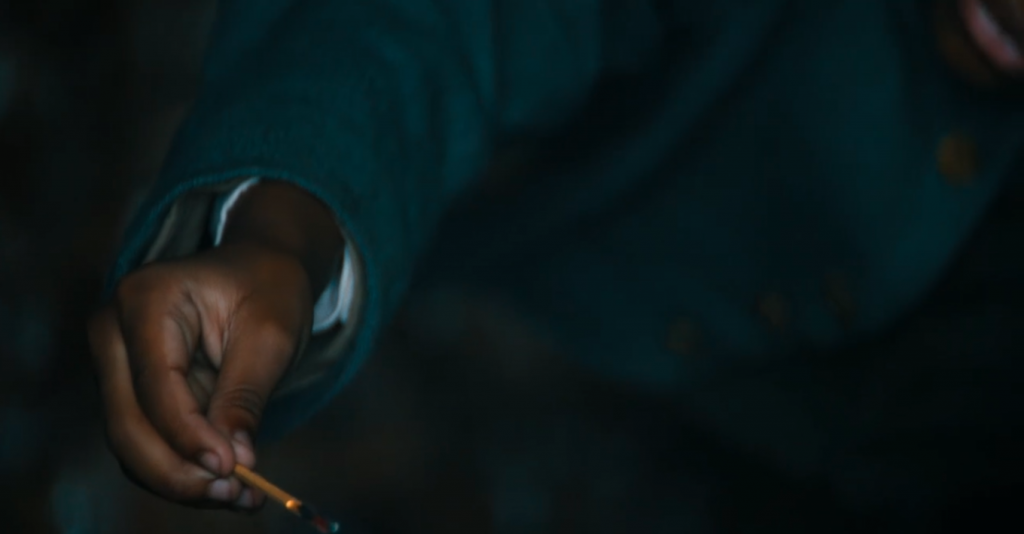
As Ridgeway returns to the farm, he meets the character Mack, a free Black man who has lived on the property since he was a child, and who, we later learn, will inherit the property when Ridgeway’s father dies. As a young man, Ridgeway convinced Mack, then a child throwing matches into a well hoping to see the Great Spirit that Ridgeway’s father talked about, to jump into the well with a match. Although Mack breaks his leg jumping into the well, the match stays lit. Directly after meeting Mack, we get a brief flashback to Mack in the well, and a match that is about to be extinguished, both foreshadowing future events in the episodes, and introducing the potent symbol of light in the darkness that is highly significant to the episode.
One of the ideas played within the episode seems to be whether Ridgeway is redeemable. At first, the episode seems to suggest that it is possible that underneath all the evidence of darkness and evil we see him perpetuate, that he may have some light within him. He provides Cora, the slave he has apprehended and the main character of the story, with shoes, and a nice dress, and he takes her to dinner. She asks why, and quickly it becomes clear that this hint of kindness is actually part of a dark fantasy Ridgeway has about apprehending Cora’s mother, who escaped his best efforts to apprehend her when Cora was a child.
Ridgeway constructs this fantasy as being fundamentally tied to the [white] American imperative of domination. Indeed, talking to Cora, he argues, the American spirit is to “subjugate, [and], if not subjugate, exterminate, eliminate. Our destiny by divine prescription. The American imperative.” Ridgeway appears to be a true believer in extinguishing hope, and in subjugating, exterminating, and eliminating as core parts of the American Creed. In this, the show represents Ridgeway as an embodiment of white racial oppression.
Later in the episode, Cora manages to escape, aided by some men who are connected to the underground railroad. As she leaves, she turns back to kill Ridgeway, now chained to his bed, knowing that he will hunt her down forever, that there is no escape so long as he is alive. However, she is stopped by Mack, who promises to kill Ridgeway himself. The next morning, Mack enters the room Ridgeway is chained in to kill him. After some conversation, Ridgeway says:
When the light is gone and only the shadow remains, the great spirit is nothing compared to the will of a heart that’s overrun with hate.
In this, Ridgeway argues that he is not only the embodiment of white racial oppression but also shadow and darkness. For Ridgeway, this is the root of power, an obsessive power that surmounts everything in its path allowing him to find, subjugate and eliminate slaves whenever he finds them.
And so, it is no great surprise that when Mack hobbles downstairs to get Ridgeway a final drink before he shoots him, that his candlelight is extinguished, and he must once again light a match.
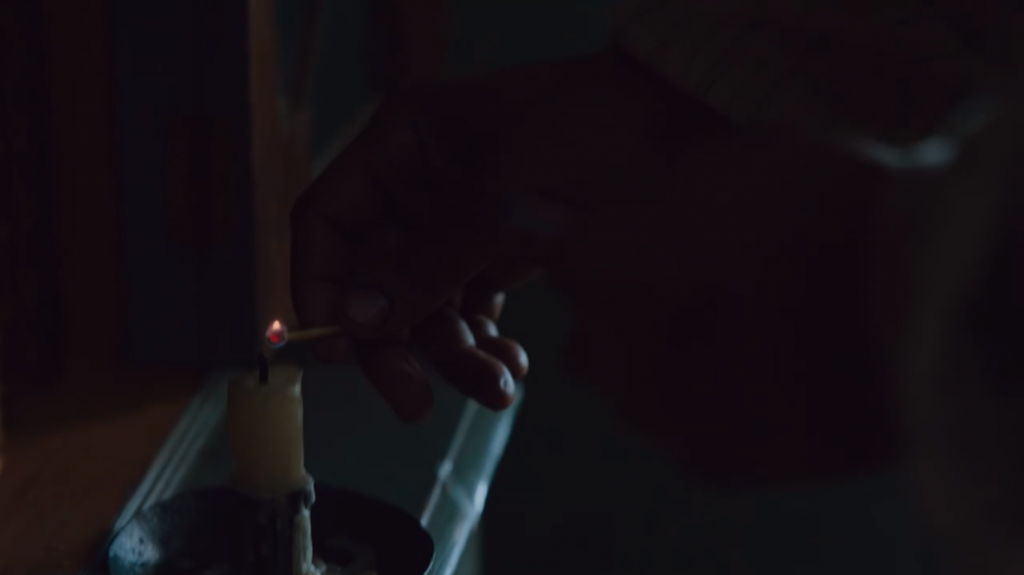
He lights the match, lights his candle, and then his own light is extinguished by Ridgeway’s loyal servant child, Homer, who shoots him from behind and frees Ridgeway. And thus, Ridgeway is free once again to act as darkness and the embodiment of a certain truth about the darkness of slavery and racial oppression and its corrupting effects on the human heart.